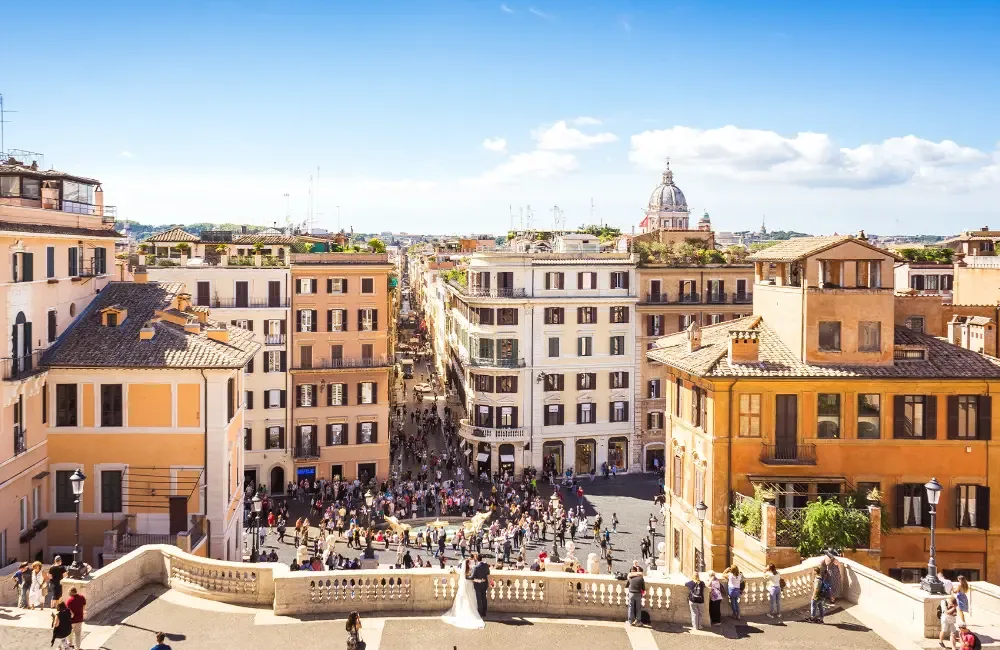


Everyone knows the Colosseum. Most tourists have St. Peter’s Basilica and the Pantheon on their itinerary. But Rome, with its 2,700 years of history, hides wonders that escape even the most prepared visitor. In quiet corners, behind ivy-covered walls, and beneath the city’s busy surface, lie monuments that whisper forgotten tales. In this guide, you’ll discover the secondary monuments of Rome — places rich in beauty, mystery, and meaning. These are not “minor” in value, only in fame. They await curious travelers willing to look beyond the obvious and embrace the city as Romans do — slowly, and with a sense of wonder.
1. The Pyramid of Cestius: an egyptian echo in the roman skyline
Set near the Porta San Paolo, the Pyramid of Cestius surprises everyone. Built around 18–12 BC as the tomb of Gaius Cestius, a Roman magistrate, it was inspired by Egypt’s fashion after the conquest of the Nile. The pyramid rises 36 meters high and is constructed entirely of white Carrara marble. Unlike Egypt’s massive tombs, this pyramid is slender and sharp — a blend of Roman engineering and eastern fascination. It stood alone in the countryside for centuries until the city grew around it. Today, it’s one of Rome’s most surreal monuments, juxtaposing ancient funerary architecture with modern chaos.
2. Porta Magica: alchemy and secrets in Piazza Vittorio
Tucked away in the gardens of Piazza Vittorio, the Magic Door (Porta Magica) is a relic from a 17th-century villa once owned by the alchemist Massimiliano Palombara. The door is engraved with Latin and Hebrew inscriptions, mystical symbols, and alchemical formulas. Legend says the door hides the secrets of transmutation and eternal life. No one has ever cracked its meaning. But its presence invites the visitor into a Rome of mystery — where magic and science once intertwined, and where monuments were messages waiting to be decoded.
3. Basilica of San Clemente in Rome: a journey through three layers of time
Just a short walk from the Colosseum, the Basilica of San Clemente seems like any other church — until you go underground. Beneath its 12th-century surface lie two more levels: a 4th-century basilica and, below that, a 1st-century Roman house with a Mithraic temple. Visiting San Clemente is not like entering a building. It’s like descending through time. Each level reveals a different layer of Rome — Christian, pagan, imperial. Frescoes, mosaics, and ancient graffiti guide you through a spiritual and archaeological experience that rivals any museum.
4. Mausoleum of Augustus: the silent giant along the Tiber
Recently reopened after decades of closure, the Mausoleum of Augustus is one of the largest circular tombs in the world. Built in 28 BC by the emperor himself, it once held the ashes of Augustus and several other Julio-Claudian emperors. For years, this immense structure stood silent and forgotten. Now, after restoration, visitors can once again walk through its concentric corridors and reflect on the rise and fall of a dynasty that shaped Western history. Unlike the Colosseum, the mausoleum invites quiet contemplation, not spectacle.
5. Quartiere Coppedè: surreal Rome in the heart of the city
If you walk through the Trieste district, you might stumble into something extraordinary: the Coppedè Quarter. Designed in the early 20th century by architect Gino Coppedè, this small area blends Art Nouveau, medieval, baroque, and Gothic elements in a way that feels straight out of a fairy tale — or a dream. Wrought-iron chandeliers hang over archways. Facades are decorated with mythical creatures and floral patterns. It’s one of the most unusual and photogenic areas in Rome, yet almost entirely unknown to casual tourists. Come for the architecture, stay for the surreal atmosphere.
6. Protestant cemetery: beauty, peace, and Shelley’s Grave
Near the Pyramid of Cestius lies the Non-Catholic Cemetery, often referred to simply as the Protestant Cemetery. Here, among cypress trees and ancient stones, lie the graves of Romantic poets like John Keats and Percy Bysshe Shelley, alongside diplomats, artists, and philosophers. Unlike the monumental cemeteries of Paris or London, this Roman sanctuary feels intimate and alive. Cats roam between tombs, flowers bloom year-round, and silence reigns. It’s a place to reflect not on death, but on beauty, memory, and art.
7. Torre Argentina: where Caesar fell in Rome, cats now reign
In the center of Largo di Torre Argentina lies a set of ruins often overlooked by passersby. But this spot marks one of the most significant moments in history: the assassination of Julius Caesar in 44 BC. Scholars believe the Theatre of Pompey, where Caesar was stabbed, stood right here. Today, Torre Argentina is home to a cat sanctuary. Dozens of felines lounge among broken columns and stone steps. It’s a Roman paradox — a site of betrayal and blood turned into a place of peace and purring. Only in Rome can history be so layered, and so lovingly absurd.
Good vibes in Rome
Rome doesn’t give herself away all at once. The more you wander, the more she whispers. These lesser-known monuments aren’t detours. They’re invitations — to curiosity, to quietude, and to a deeper connection with the Eternal City. So next time you visit Rome, take a different path. Follow the shadow of a pyramid. Read the riddle on a magic door. Sit beside Keats’s tomb. Let the city surprise you. Because in Rome, even the unknown is unforgettable.
(photo credits: Freepik)
Related post